


Articles scientifiques
Social Relationships in Female Bonobos
Auteurs:Ryu H. Année de publication:2024 Date de publication:30/01/2024
Abstract
Feeding competition and predation risk are two important factors determining female reproductive success and interfemale relationships (Sterck et al. 1997). Although an increase in the number of individuals in a group can reduce the predation risk for each individual, it also increases competition over food. As feeding competition directly influences female reproductive success, there may be an optimal number of females in a group depending on the social and ecological situation (Markham et al. 2015). When the number of females in a group increase, competition between females over food will also increase. Such competition over food will result in a species-specific social structure that results from struggling of females to acquire a better social position (Barton et al. 1996; Kappeler and van Schaik 2002; Pusey and Schroepfer-Walker 2013). After an establishment of social structure, the social structure will then stabilize how local resources are distributed to females and influence fitness of each female. For example, increased contest competition over food may result in a more linear hierarchy that may reduce one’s fitness in a lower hierarchy as it will reduce the chance of access to food to them (Sterck et al. 1997). In such a group, group females may not be able to utilize the maximum local carrying capacity as resources will be distributed unequally and may result in surplus and scarcity for individuals in different hierarchies. On the other hand, if females are tolerating each other, so the social structure does not hinder resource allocation between females of different social ranks, this tolerant social structure may help females even in a lower social rank utilize the local resource better (Hamilton et al. 2009)
Conclusions
In the current chapter, I showed that age and the existence of a son are the two most important factors that explain interfemale variations in grooming, sexual interactions, and neighboring individual distribution in bonobos. Although female social rank is usually higher in older female bonobos (Douglas et al. 2016; Tokuyama and Furuichi 2016), the increase in social rank with age did not prevent a decrease in the frequency of social interactions in old females. How can we understand this opposing relationship between the rise of social status and the decrease in social association in old females? In addition, in such a case, how can an old female with a high social rank can exert influence on bonobo society? We do not know the answer yet. However, let us start with the null hypothesis describing female associations and interactions as a simple reflection of the necessity of grooming for hygiene, and copulation for reproduction. GGR in this scenario simply exploits a neural system and reproductive organs that are evolved to facilitate copulation.
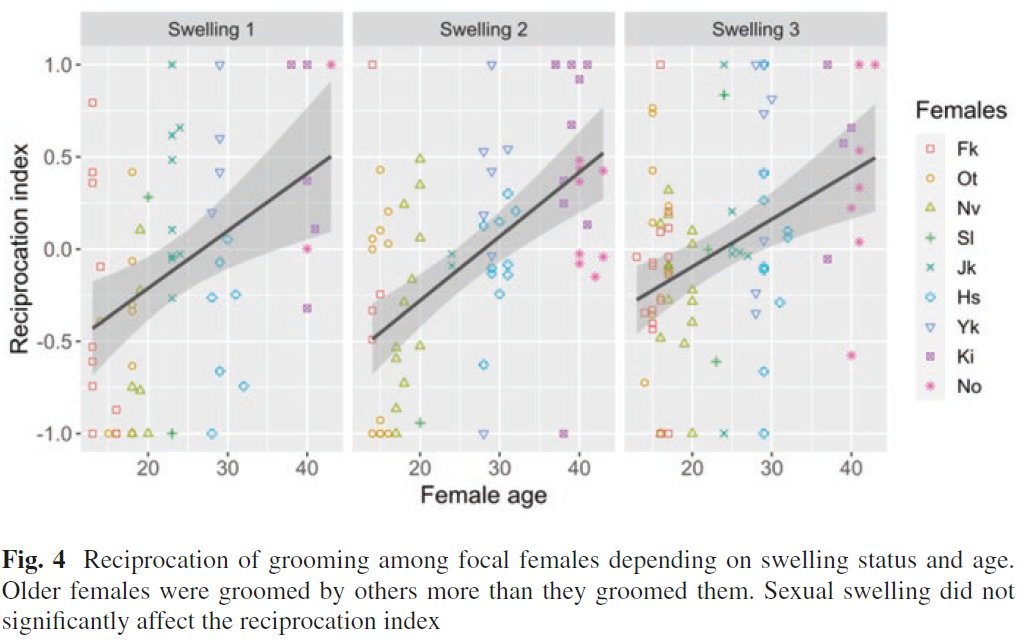
As shown in the current chapter, the most preferred grooming partner of a femal may be her son. This kin-biased grooming pattern is consistent with previous findings in other primate species (Silk 2009). However, other factors, such as reciprocity (Schino and Aureli 2010) could also explain such kin-biased partner preference. For example, female bonobos may prefer their sons because they are the most reliable grooming partners that reciprocate grooming better than other individuals in the group. In this case, such kin-biased grooming interactions of a mother with her son can be better explained as it fulfilling hygienic purposes rather than the grooming interaction increasing the change of social support from her grooming partner. In addition, old individuals are not less preferred grooming partners, as far-sightedness may reduce grooming performance (Ryu et al. 2016). If these are the case, simply looking at female social interactions may not be enough to estimate the importance of females in the bonobo society. Nevertheless, given the fact that old females were groomed by other females the most, even though they did not reciprocate it to other females (Fig. 4), there will be some important social reasons for young females to engage in grooming with high-ranking females. Further investigation on grooming reciprocity between individuals and its correlation with social and ecological factors that influence interactions between individuals will clarify whether partner preference in grooming of bonobos is more likely explained by reciprocity, or by other social or ecological factors.
Female bonobos live in a male-philopatric society wherein females disperse from their natal group. Compared with chimpanzees, which are their closest relatives, bonobos form a more female-centered and tolerant society (Furuichi 2011). However, we do not have a scientific consensus that explains how such a bonobo society could have evolved. One can argue that strong female–female bonding, rich ecological conditions, or even extended receptivity from prolonged maximal swelling was the driving force that has shaped bonobo society (Furuichi 2011; Tokuyama and Furuichi 2016; Ryu 2017; Surbeck et al. 2021). Nevertheless, there could be another important factor that we might have overlooked. We need more comparative and collaborative research between different study sites to better understand the evolution of bonobo society. This will also help us to draw a better model of human evolution. Time to study bonobos in the wild may be running out, due to increasing challenges in bonobo conservation resulting from human impact and the emergence of zoonotic diseases. However, I believe that bonobo researchers, conservationists, and people who live with bonobos and support bonobo research and conservation can make a difference, as we have done for Wamba last 50 years. I hope that more and more people can help bonobos and people at Wamba, so we can witness the next 50 years together.