


Scientific papers
Within- and Between-Group Kin Structure of Wild Bonobos in Comparison to Other African Great Apes
Auteurs:Ishizuka S. Année de publication:2024 Date de publication:30/01/2024
Abstract
Bonobos (Pan paniscus) are one of the closest evolutionary neighbors to humans. They live in societies that contain various rare traits among animal species. Unlike most primates that form female-philopatric groups (Wrangham 1980; Lawson-Handley and Perrin 2007), bonobos form male-philoparic groups, in which males remain in their natal groups and females disperse after sexual maturity (Kano 1992; Hashimoto et al. 2008; Sakamaki et al. 2015). Although females within groups are typically immigrants and assumed to be nonkin with each other due to female dispersal, female bonobos are very social and play an important role in creating the peaceful nature of their society (Furuichi 2011). They often show affinitive and cooperative interactions with each other (Parish 1996; Tokuyama and Furuichi 2016; Moscovice et al. 2017). In contrast to females, male bonobos are typically unsocial. Compared to chimpanzees (Pan troglodytes), the closest evolutionary neighbors of bonobos, the intensity of male aggression is moderate (Ihobe and Furuichi 1994; Stanford 1998; Wilson et al. 2014; Surbeck and Hohmann 2017), and cooperation among males is seldom observed (Surbeck and Hohmann 2013; Tokuyama and Furuichi 2016; Surbeck et al. 2017a). Furthermore, although intergroup relationships are typically antagonistic in primates, those of bonobos are highly tolerant and even peaceful. When neighboring bonobo groups encounter each other, they often merge peacefully, and affinitive interactions and copulations among individuals from different groups are often observed (Idani 1990; Hohmann and Fruth 2002; Lucchesi et al. 2020; Tokuyama et al. 2020). It remains unclear why such unique characteristics have evolved in our closest living relatives. Clarifying the factors facilitating the evolution of such unique characteristics in bonobo societies could contribute to understanding how dynamic and flexible cooperation has evolved in humans.
Conclusions
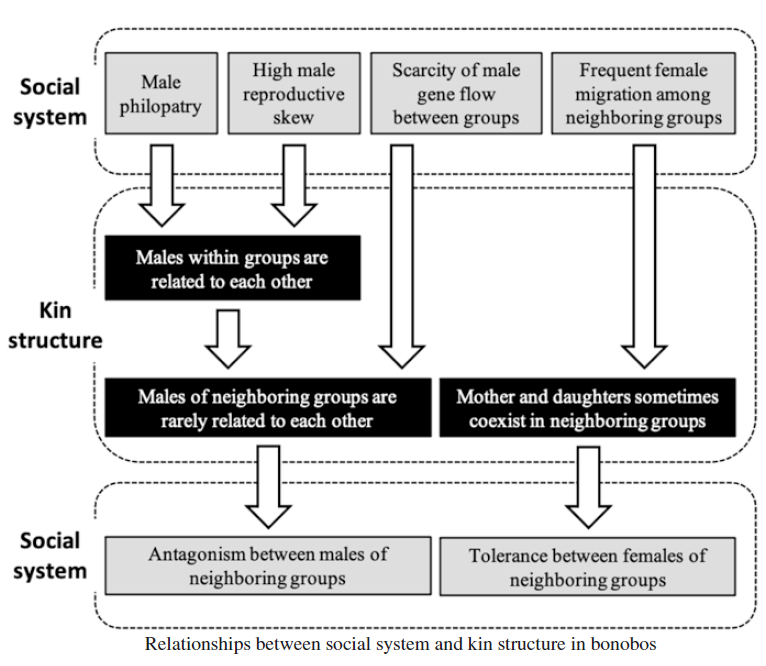
Males within groups are typically related to each other in bonobos, which is similar to that observed in chimpanzees and gorillas forming multi-male groups. This is assumed to be because males of these species can stay philopatric. In contrast, kinship among males of neighboring groups is usually rare in bonobos and chimpanzees, but not in gorillas. This difference may be because only male gorillas can disperse and form new groups near their natal groups, which results in the coexistence of male kin in neighboring groups.
Although female dispersal is commonly observed in African great apes, kinship among females within groups seems to be less frequent in bonobos than in chimpanzees and gorillas. This is possibly because females that remain philopatric and give birth within their natal groups are more common in chimpanzees and gorillas than in bonobos. In contrast, the tendency in which several female kin coexists in neighboring groups seems consistent among the African great apes, which may be because females of these species often migrate into neighboring groups and remain near their natal groups after dispersal.
Further genetic studies of wild bonobos are required for a better understanding of their social systems and conservation of the species. Since information on between-group kin structure is scarce in bonobos, these should be investigated at other long-term study sites, such as Lomako and LuiKotale, to elucidate cross-site consistency and variation in these within- and between-group kin structures. Moreover, monitoring genetic diversity in each population and assessing the extent of gene flow among them are important for the conservation of the species, as maintaining genetic diversity in wild populations is helpful in preventing endangered species from extinction (Frankham et al. 2002). Integrating information regarding genetic diversity in each population will contribute to planning conservation strategies for our closest living relatives.