


Scientific papers
The Puzzle of Pan Tool Use: Why Are Bonobos So Different from Chimpanzees in Their Use of Tools?
Auteurs:Koops K. Année de publication:2024 Date de publication:30/01/2024
Abstract
Chimpanzees (Pan troglodytes) and bonobos (Pan paniscus) are humans’ closest living relatives. The two sister species shared a common evolutionary history until about one million years ago. Yet, despite their evolutionary closeness, chimpanzees and bonobos differ in a number of important ways. One of the most striking differences is the discrepancy in the reliance on tool use in wild populations of Pan. Chimpanzees are renowned for their extensive use of tools in a wide variety of contexts, including feeding, self-maintenance, and social contexts. Bonobos, on the other hand, use surprisingly few tools in the wild, and none in feeding. The tool use difference between the two species of Pan remains one of the most challenging topics in the study of our closest living relatives. In this chapter, I will provide an overview of what we know about bonobo tool use in the wild, and specifically how tool use at the study site of Wamba in the Democratic Republic of Congo compares to other long-term bonobo study sites. Moreover, I will summarize a number of comparative studies on wild bonobos and chimpanzees, which have aimed to elucidate the drivers of the tool use dichotomy between the two species. Lastly, I will discuss future research directions in the study of tool use in our ape relatives.
Conclusions
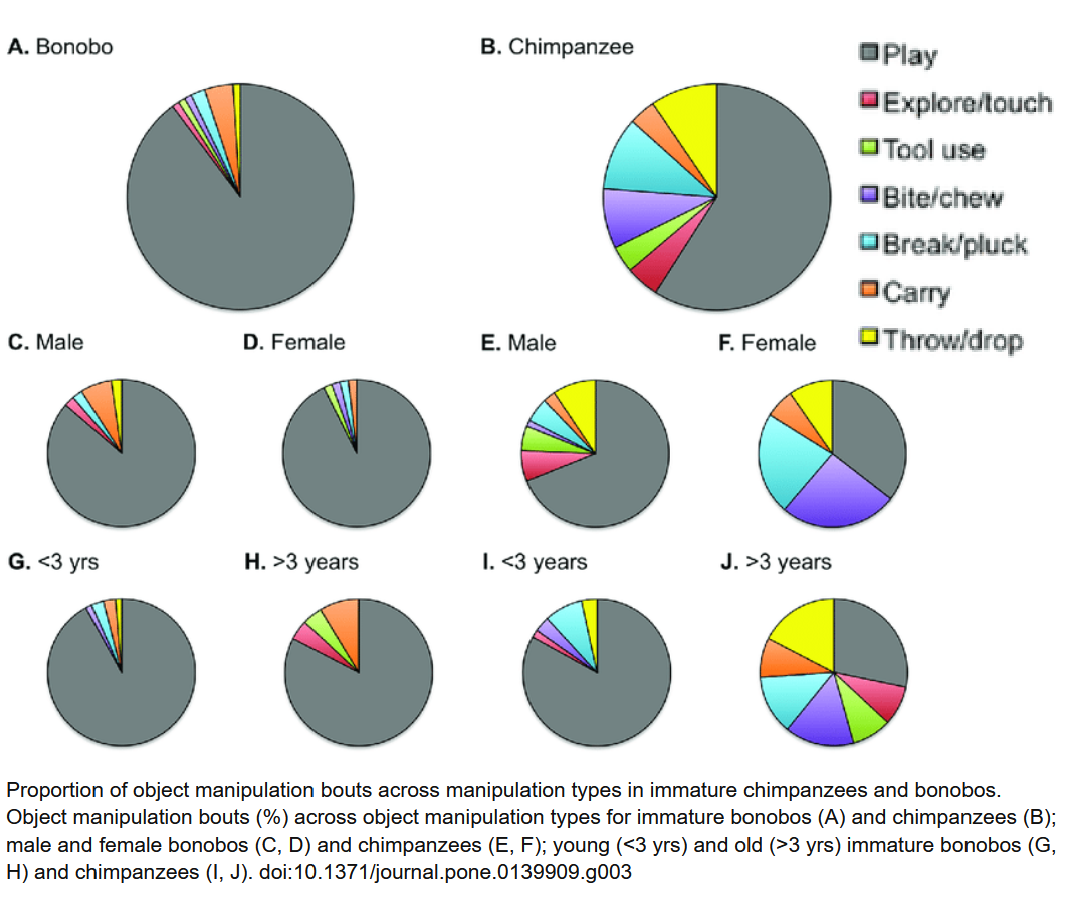
The (near) absence of bonobo foraging tool use in the wild remains a tantalising question. Comparative field research on chimpanzees and bonobos has helped to shed light on some of the possible drivers of the tool use difference in Pan. The intrinsic motivation to interact with objects was found to play a key role in explaining the tool use dichotomy between chimpanzees and bonobos. The ecological and social factors considered were not found to explain the observed differences in tool use. However, future research is needed to address the potential role of energetics in explaining tool use patterns (i.e., Relative Profitability Hypothesis). Moreover, research is required to address the role of ecological and social inputs during the development of tool use across different species of apes. Such an integrated comparative and developmental approach will help to further advance research on the evolution of tool use.